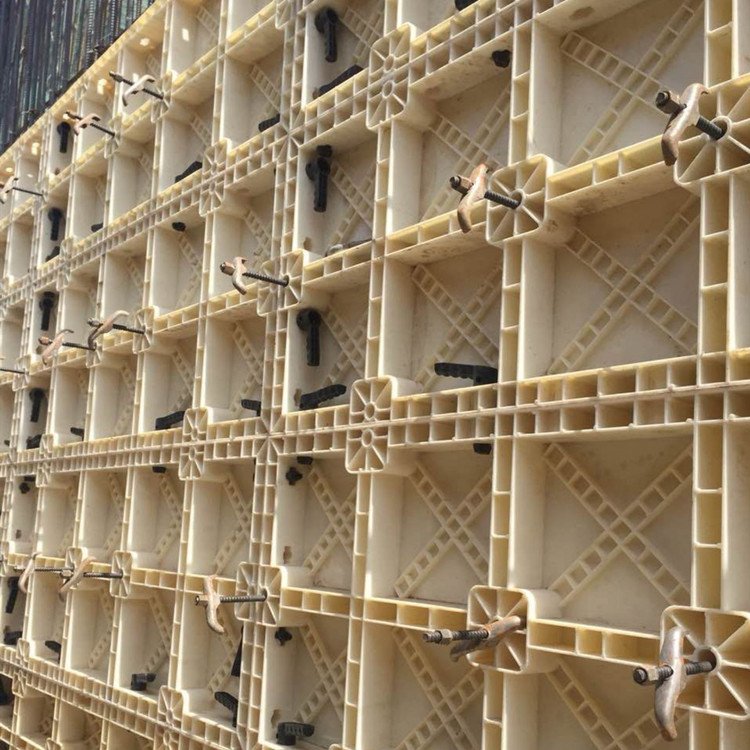

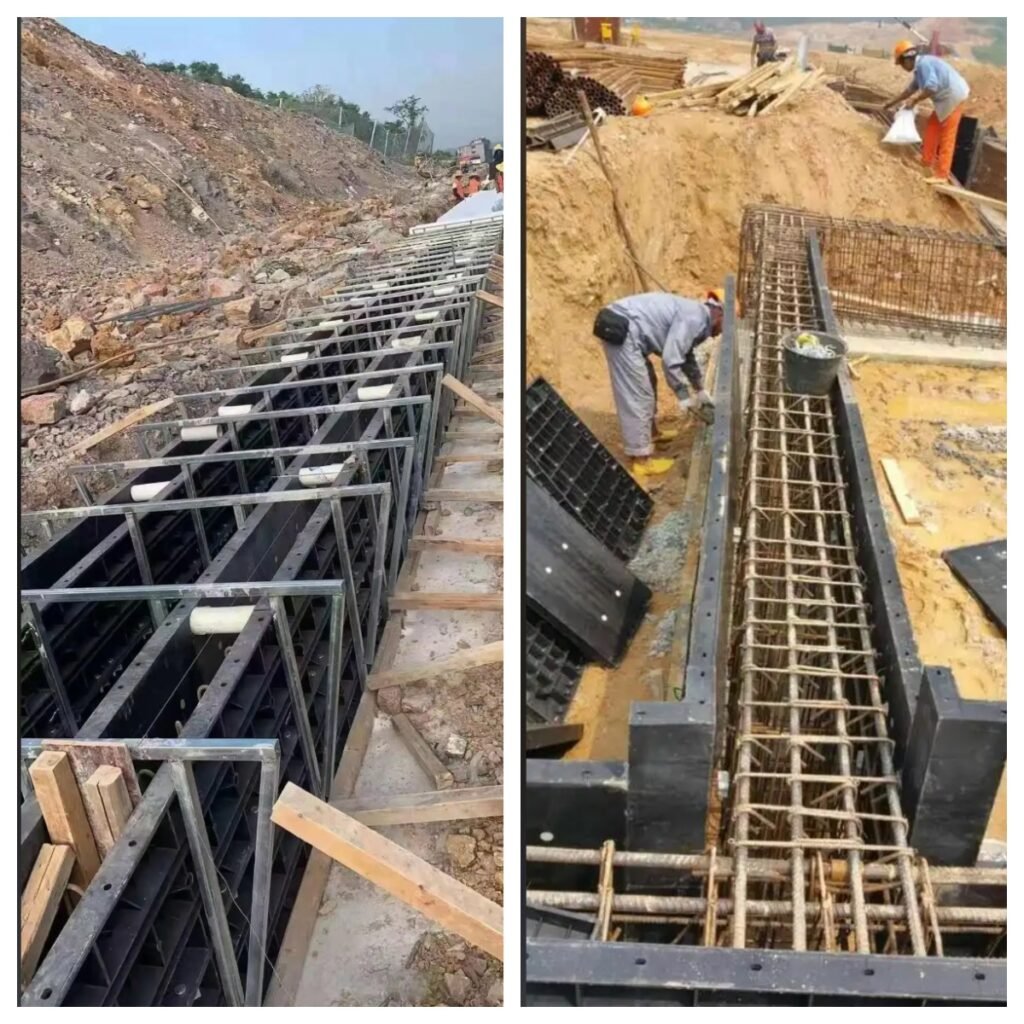
Drainage ditch and retaining wall construction demands formwork solutions that balance quality, speed and budget. Traditional timber formwork faces persistent pain points: limited reusability, moisture deformation, heavy on-site cutting and volatile lumber costs. Our high cost-effective PP plastic concrete formwork is now widely deployed on these civil sites. Manufactured from modified polypropylene, this modular system is water-resistant, lightweight and reusable dozens of times. It delivers smooth concrete surfaces, cuts labor and material waste, and simplifies assembly and demolding. In this article, we break down its on-site performance, lifecycle cost advantages and sustainability benefits for ditch and retaining wall projects.
1. The Pain Points of Traditional Formwork for Ditch & Retaining Wall Projects
Concrete formwork acts as critical temporary support in civil engineering. Drainage ditches and retaining walls are typical linear civil structures, where contractors repeatedly search for economical and dependable formwork systems to accelerate construction while guaranteeing concrete surface quality.
Timber formwork has been the mainstream choice for small and medium infrastructure for decades. Nevertheless, it has inherent weaknesses for ditch and retaining wall works. Wood can only be reused a small number of times. It absorbs water from fresh concrete easily, leading to swelling, warping and rot, especially in damp ditch sites. Workers need plenty of on-site cutting, which creates massive waste and relies heavily on skilled carpenters. In addition, timber prices keep fluctuating, making budget forecasting difficult.
These drawbacks push contractors to seek alternative formwork solutions. Modified PP plastic concrete formwork has emerged as a practical substitute for ditch and retaining wall construction worldwide.
2. Material & Structural Advantages of Our PP Plastic Formwork
Our PP plastic concrete formwork is purpose-designed for linear structures: drainage ditches, channel walls and retaining walls. The panels are produced from modified polypropylene composite material, integrating high rigidity, impact resistance and excellent waterproof capability.
- Waterproof & dimensionally stable: Unlike timber, PP panels do not soak up moisture from wet concrete. They stay intact without swelling or deformation in humid ditch working environments.
- Superior concrete surface: The dense, smooth panel surface creates uniform concrete texture after stripping. Secondary plastering can often be eliminated, saving extra materials and working hours.
- Modular design: Standard panels can be freely assembled to fit different ditch widths and retaining wall heights. Matching accessories such as braces and tie rods secure the whole system against lateral pressure during concrete pouring.
3. Core Value: Outstanding Cost Performance Over the Project Lifecycle
Cost-effectiveness is the biggest highlight of this PP formwork system. Many buyers are concerned about the initial purchase cost. However, total lifecycle cost is far lower than timber formwork.
A single PP panel can be reused dozens of times across multiple jobsites, while timber formwork can only survive a few pours. For ditch and retaining wall projects with repeated cross-sections, the reusability brings substantial long-term savings.
Other cost-saving factors:
- Lightweight panels: Workers handle and assemble panels without heavy lifting machines.
- Minimal on-site cutting: Reduce raw material waste and cut labor expenses.
- Fast assembly & demolding: Shorten overall construction duration, lowering site rental and management costs.
- Less release agent required: Oil-based release agents are unnecessary in most scenarios, cutting auxiliary costs and site contamination.
Operational learning is simple. Site crews can master the installation quickly after basic training. After concrete curing, panels can be stripped rapidly, cleaned with water and reused for the next pour.
4. On-Site Performance in Ditch and Retaining Wall Construction
Ditch and retaining wall projects are usually built in continuous sections, which perfectly matches the characteristics of modular PP plastic formwork.
During pouring, the matched bracing system firmly holds panels in place to resist concrete side pressure. The whole structure maintains stable geometry, avoiding bulging or displacement. Once concrete reaches required strength, demolding proceeds cleanly. Panels remain undamaged after stripping. A simple water wash removes concrete residue, ready for reuse on the next segment.
This workflow greatly improves construction continuity, ideal for municipal drainage, roadside ditches and slope retaining walls.
5. Environmental & Sustainability Benefits
Green construction standards are increasingly adopted globally. Timber formwork consumes forest resources, while reusable PP plastic formwork drastically reduces timber demand.
When panels finally reach the end of service life, they can be recycled. This circular feature helps contractors meet local environmental regulations and build a greener project profile.
6. Custom Formwork Solution & Technical Support for Contractors
For contractors working on drainage, channel and retaining wall projects, formwork selection directly determines project profit margins. Our PP plastic formwork balances finished quality, construction speed and total investment. It reduces reliance on experienced carpenters and enables predictable cost control.
If you are sourcing reliable formwork systems for ditch and retaining wall projects, contact our engineering team today. We offer customized formwork layout design, full on-site technical guidance and complete after-sales service tailored to your project specifications.
Get your tailored PP plastic formwork proposal now. Send your project drawings and dimensions to our team, and we will provide professional formwork layout and cost calculation for your ditch or retaining wall project.