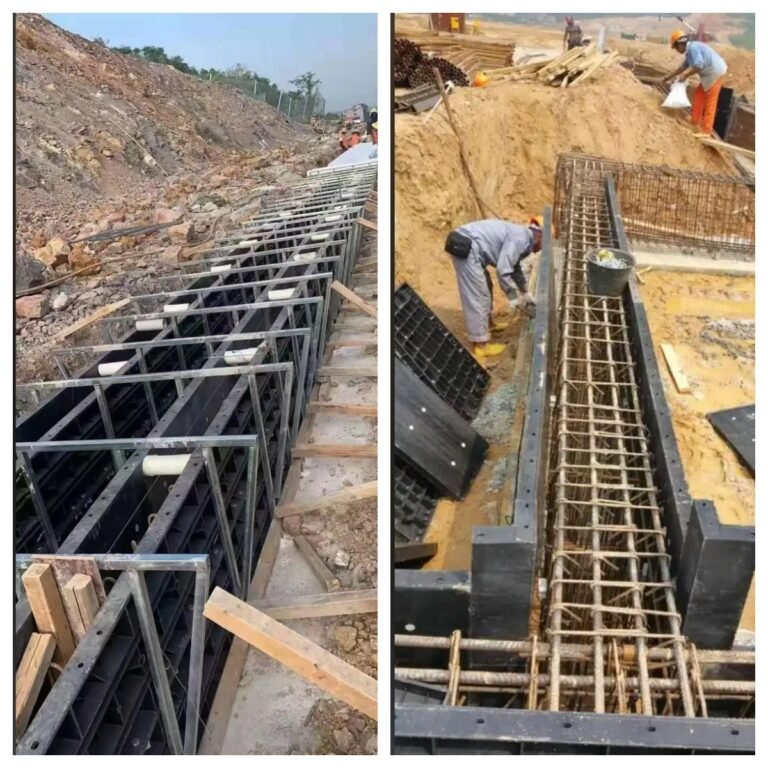

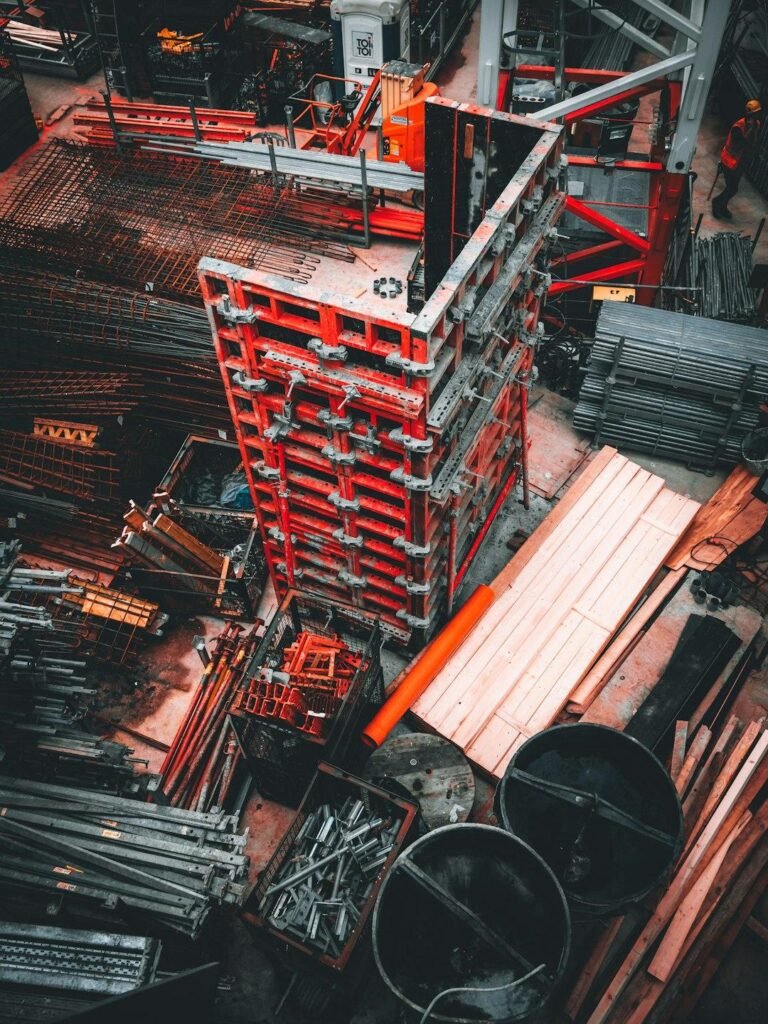
Concrete formwork is a critical temporary structure in building construction, which directly affects the forming quality, construction efficiency and safety of concrete members. Reasonable selection of formwork materials is vital to project cost control, construction schedule and on-site safety management. According to project scale, service cycle and construction demands, steel formwork, plastic formwork and wooden formwork are applied to different construction scenarios respectively. The detailed characteristics and application advantages of each formwork type are listed as follows:
1. Steel Formwork for Large-Scale Construction Projects
Steel formwork is the priority option for large-scale, high-rise and infrastructure projects, which needs to be matched with heavy construction machinery for operation. Its core advantages are reflected in cost, bearing capacity and construction safety:
- Low unit use cost and high reusability: Steel formwork has far more turnover cycles than plastic and wooden formworks. The high reuse rate greatly reduces the single-use unit cost, bringing significant cost benefits to large-volume and long-cycle construction projects.
- High bearing capacity and structural stability: It features excellent structural rigidity, which can effectively resist the lateral pressure generated by concrete pouring and vibration. It avoids formwork deformation, displacement and structural failure during construction.
- High construction safety and molding quality: It meets the stringent safety standards of large engineering projects, greatly improving on-site construction safety. Meanwhile, it ensures high flatness and dimensional accuracy of finished concrete surfaces.
2. Plastic Formwork for Medium and Small-Scale Construction Projects
Plastic formwork is highly suitable for medium and small-sized projects, with prominent advantages of manual operation, high reusability and flexible assembly:
- Machinery-free construction: The formwork is lightweight and easy to operate. The whole process of assembly and disassembly can be completed manually without heavy construction machinery, which saves equipment leasing and operating costs and simplifies on-site construction procedures.
- Excellent cost performance: High-quality plastic formwork can achieve more than 100 turnover cycles. The high reuse rate effectively amortizes initial procurement costs and reduces the overall construction cost of medium and small projects.
- Strong dimensional flexibility: It supports free splicing and combination, which can adapt to diverse structural sizes and irregular concrete components, greatly improving the practicability and applicability of on-site construction.
3. Wooden Formwork for Temporary Construction Projects
Wooden formwork is the most economical choice for short-cycle temporary construction works, with outstanding cost and flexibility advantages:
- Lowest comprehensive cost: It has the lowest procurement price among the three mainstream formworks, with no additional auxiliary investment, which minimizes the overall cost of temporary construction projects.
- Ultra-high construction flexibility: Wooden formwork can be arbitrarily cut and trimmed on-site to adapt to various temporary structures, including temporary supports, temporary foundation pouring and on-site service facilities.
- Targeted applicability: Although it has a low turnover frequency and is mostly used for single use, it fully meets the basic concrete forming requirements of short-cycle and simple temporary construction scenarios.
In summary, the selection of concrete formwork must be based on actual project conditions. Specifically, steel formwork is suitable for large projects relying on its high safety and low unit cost; plastic formwork is ideal for medium and small projects due to its convenient manual operation and flexible splicing performance; wooden formwork is the optimal option for temporary projects with its low cost and strong on-site adaptability. Scientific and reasonable formwork selection and matching can effectively improve construction efficiency, control project costs, and guarantee construction quality and on-site safety.