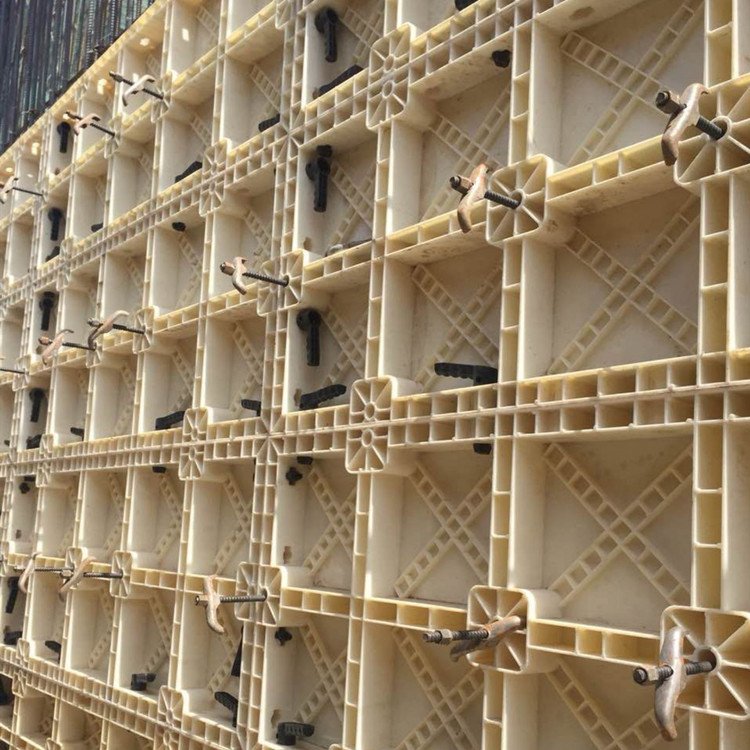

Lightweight and high-efficiency building materials have become essential in modern construction to boost on-site productivity and cut labor costs. Traditional wooden and steel formwork have prominent disadvantages: they are heavy, time-consuming to install, rely on multiple workers, and easily deform during concrete pouring. As a superior replacement, reusable plastic construction formwork delivers excellent practicability and structural stability. Our standard plastic formwork measures 1500mm in length and 500mm in width, with each panel weighing only 10.25 kilograms. The ultra-light design enables single-person handling and installation, greatly reducing labor pressure, shortening construction periods and lowering overall project expenses.
Adopting a modular design with user-friendly connecting structures, this plastic formwork requires no professional construction experience or sophisticated tools. Unlike traditional formwork that demands team cooperation, it supports fast and flexible on-site assembly. The entire installation process is standardized into three intuitive steps, which effectively reduces construction errors and guarantees smooth, uniform and high-quality concrete molding for walls and floor slabs.
Step 1: Splice Formwork Panels
Start construction by assembling formwork panels. Workers connect individual plastic formwork units with dedicated connecting handles. The customized handle structure ensures tight fitting and firm locking, eliminating gaps and panel displacement. According to construction drawings and actual engineering size requirements, workers flexibly splice and combine the panels to form an integrated, standard-compliant formwork frame. This versatile splicing method fits most conventional concrete pouring scenarios for building walls and beams.
Step 2: Install Plastic Sleeves and Through-Wall Rods
Once formwork splicing is finished, install precision plastic sleeves at reserved mounting positions. These key accessories accurately control concrete pouring thickness, solving common problems such as uneven wall thickness and irregular structural dimensions, and significantly improving construction precision. After securing the plastic sleeves, insert supporting through-wall rods through the sleeves and formwork. This operation completes the preliminary positioning of the whole formwork system, laying a stable foundation for subsequent reinforcement and concrete pouring.
Step 3: Reinforce with Steel Pipes and Tighten Nuts
To withstand strong lateral pressure from poured concrete and prevent formwork bulging, deformation and shifting, reinforce the outer side of all through-wall rods with square steel pipes. The steel pipe support enhances the overall rigidity and stability of the formwork system, ensuring structural safety during construction. Finally, tighten the matching nuts at the outer ends of the through-wall rods to firmly fix the steel pipes and formwork. A quick inspection of overall flatness, firmness and tightness completes the entire installation process.
With its lightweight body, simple three-step standardized installation and reliable reinforced structure, this plastic formwork greatly simplifies traditional complex construction processes. It is an economical, durable and highly efficient new building material, widely suitable for concrete construction of residential buildings, commercial complexes and various infrastructure projects.
Leave your message, and Zhuniu Formwork Company will matching concrete formworks suitable for you and best discount !!